Wednesday, 20 May 2015

Next up: Poetry

Hello Y11,

So, your next exam is English Literature Paper 2: Poetry Across Time.

Remember, you will get a clean Anthology in the exam.

My hunches for this exam are as follows, but remember that anything could come up - you need to know all of the poems and know plenty of them inside out.

Top hunches:
My Last Duchess
Medusa

Others that haven't come up for a while:
Checking Out Me History
The Clown Punk
The Hunchback in the Park

Here's my exam guide:


And here's a couple of past papers:


Here is the top end of the mark schemes for section A and B:


You can find lots of other poetry resources by clicking on 'Character and Voice' in the browse by topic menu, here --------------------------------->

Finally, some links for poems which are not mentioned above. Here are two essential articles on 'Medusa' and 'Singh Song' by the authors themselves.

I'm also intending to finish another model answer on 'Portait of a Deaf Man' and 'Casehistory: Alison' - the one we started in the lesson the other day.

Good luck!


Mr M

Saturday, 16 May 2015

A reminder: Crooks

Hi,


Th doc below is particularly useful in showing the ways in which Steinbeck presents Crooks.

Note the similarities with Curley's Wife in that he lives his life under 'layers of protection' - perhaps they all do.

Another key quote is the one about his deep set eyes that 'glittered with intensity'. This represents the light, the hope, the dream that lays buried deep inside of him. However, this innocent dream of the past has been damaged by bitter experience. Now he is sullen and cynical; he knows he has to keep people at arm's length to protect himself.

In this chapter, Steinbeck makes him physically grow - but then shrink again as a result of Curley's Wife's attack. In the end, the circular structure (not that again!) of the chapter shows he's going nowhere.

Anyway, here's the doc:


Mr M


English Lit 1: Monday

Hello Y11,


Stay calm - it's English Lit 1 on Monday!

First thing to remember: BRING YOUR COPIES OF THE TEXTS!

Next, double check that you know what to do in the exam. Here's my exam guide:


 And a past paper: 


And here are the top ends of the two mark schemes:


Finally, don't forget the importance of writing about the writer's methods. The words Priestley and Steinbeck must be prominent in your responses. Remind yourself of the writer's methods: Priestley here and Steinbeck here:


Finally, please look at the Browse by topic section on the right on the page for more stuff on the texts.

I'll be posting more over the weekend. Also, follow us on Twitter for last minute advice and to fire your panicky last minute questions at us!


Good luck troopers!


Mr M

Thursday, 30 April 2015

Video Clips: Singh Song and Checking Out Me History

Hi,


Here are links to the video clips we watched in lesson on these two poems. The first and third links are to readings of the poems, the second and fourth are explanations from the poets, Daljit Nagra and John Agard.

Daljit Nagra reads Singh Song!
Daljit Nagra on Singh Song!

John Agard reads Checking Out Me History
John Agard on Checking Out Me History


Enjoy!


Mr M


Daljit Nagra on 'Singh Song'

Click on Daljit for his explanation of the poem...

PS. The ending is not 'cheesy'!

http://www.sheerpoetry.co.uk/gcse/daljit-nagra/singh-song

Les Grands Seigneurs: Thoughts about structure

Hello,

A typical courtly lover - wounded by Cupid's arrow
I don't think I need to blog at great length about Les Grands Seigneurs by Dorothy Molloy. It's pretty straight forward. Although it appeared on the 2014 paper, it compares well with my tips (Medusa and My Last Duchess), so it's definitely worth getting to know it inside out.

I thought it might be useful to focus on an aspect of the writer's craft that is sometimes difficult to comment on convincingly: STRUCTURE.

So what is structure?

Structure refers to:

  • how the poem is put together
  • what holds it all together
  • all those things that give the poem its shape and make it whole and coherent
  • what leads the reader through the poem
When you write about the writer's methods in the exam, comments about structure are a vital aspect. You will lose marks if you only write about language.


So, here are some thoughts about the structure of Les Grands Seigneurs:

  • The first half of the poem is a succession of images showing what men were to the speaker. These images are clustered together to develop subtle shades of meaning: first architectural images, then bird images, performing animals, ship images and musical/entertainment images. For example, the first group of images are suggestive of the medieval world of castles, knights, maidens and courtly love. 'Buttresses' suggest support, 'castellated towers' suggest protection (but perhaps isolation? entrapment? - does this foreshadow the ending?) and 'bowers' suggests comfort, relaxation and privacy. Think about why each image is included and what it adds to its cluster of images.
  • Men are the subject and focus of stanzas 1 & 2. Note the repetition: Men were... Men were... These stanzas suggest certainty and confidence in the regularity provided by the repetition.
  • There are rhymes in stanza 1, as well as a strong rhythm enhanced by assonance (strutting pink flamingos) which add to the confident dynamic voice of the speaker.
  • Stanza 3 marks a shift. Now the subject is the all-powerful speaker. The enjambment of 'out of reach' in line 9/10 enacts the idea of her being on a pedestal.
  • There are only three lines in stanza 3, and they create a kind of skewed rhyming couplet: reach/peach. However, this shortened stanza suggests that her power is short-lived.
  • The final stanza starts with 'But' - marking a bigger shift.
  • The 'wedded, bedded' bit slows the poem down and emphasises (through heavy stresses) the shift into the dreary reality of marriage.
  • The bracketed phrase (yes, overnight) adds a sense of shock and disbelief to the speaker's voice.
  • The poem ends on another skewed rhyming couplet (fluff/bluff). But this time, it seems rushed. Try reading the rhming lines in stanza 3 and then compare to the end of stanza 4: the final line is over quicker than a click of the fingers. The poem's lines have been getting progressively shorter. This recreates the sense of a sudden, shocking transformation from 'queen' to 'bit of fluff'.
I hope this helps to clarify what kind of features of the writer's craft constitute structure: think stanzas, line lengths, rhymes, patterns of imagery, rhythm/stresses.

In your revision guide thingy, you will find an 'A' grade answer to a question comparing this poem with Medusa. It's definitely worth a read. That could be your exam question - who knows?

Please remember: you need to be putting in the extra effort now. It is time. Read and re-read and re-read and re-read the poems. Read your study guide. Look at other revision resources. Fill in comparison grids and your Character and Voice connection chart. Revise!

If you need more help on any aspect of the poems that we're rushing through, please email, comment or just grab me in school. 


Mr M


On a Portrait of a Deaf Man

Hi folks,
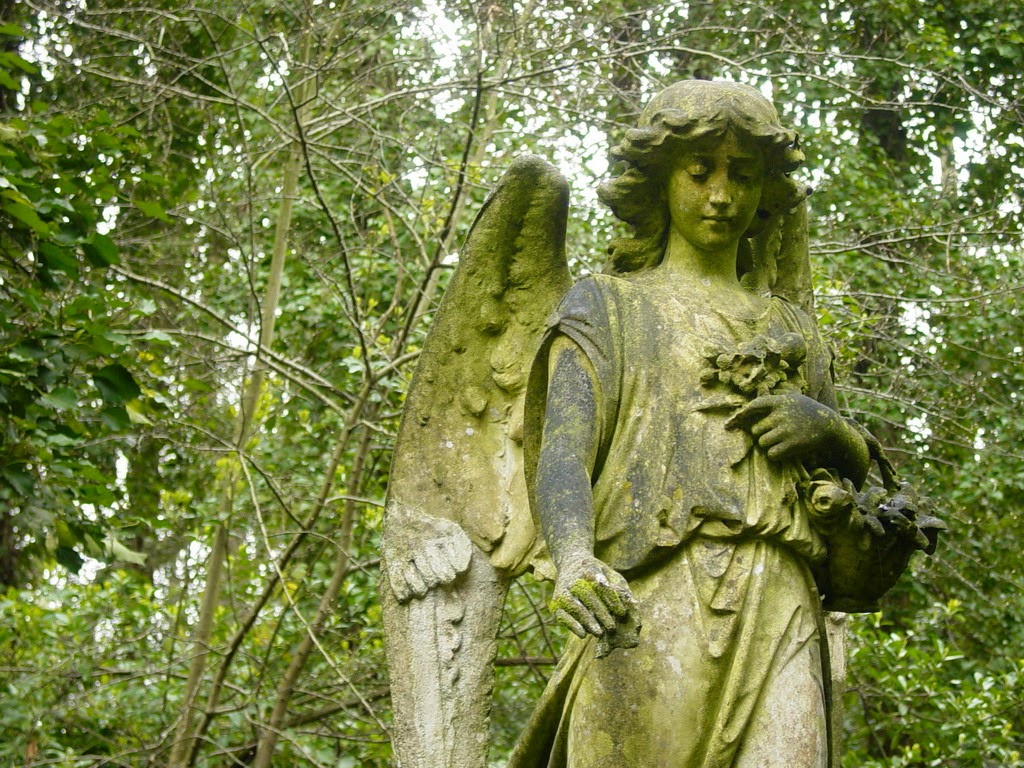
Beautiful and solemn: Highgate Cemetery

We've bashed through a fair few poems recently. Make sure you've got your head around them by reading through the Bitesize notes on Casehistory: Alison, The Horse Whisperer and On a Portrait of a Deaf Man.

It's the last poem I want to blog about because it's a belter. Why do I like this grim little poem about death? Perhaps it's because truly great literature deals with universal themes. The Romantic poet, John Keats said: 'Beauty is truth, truth beauty'. Cormac McCarthy, who wrote a novel about the end of the world ('The Road'), says that writing that is not about 'issues of life and death' is 'not literature'. What I love about this poem is that it presents the harsh truth of the reality of death without a sugary coating. We tend to live in denial about such things; great literature makes us confront these thoughts and deal with them. John Betjeman doesn't shy away from the darkest of thoughts in his grief. And he doesn't water his feelings down with euphemisms. But just like the dead wife in 'My Last Duchess', we are given a picture of the simple pleasures of life too: the food, the walks, the air. Perhaps part of the truth of this poem is that we cannot celebrate the beauty and joy of life without acknowledging the darkness of death. It's a poem of opposites.
http://en.wikipedia.org/wiki/Yin_and_yang


There's so much more to this poem than initially meets the eye. It's very carefully constructed, and there's loads to say about structure. Here's a recap of key points about this poem, and perhaps a few things we didn't notice first time around:


  • The poem is an elegy - a lament for the dead.
  • It's written in ballad metre. That means that lines 1 and 3 of each stanza are tetrameters (four stressed syllables); lines 2 and 4 are trimeters (three). This creates the same rhythm that you'll know from all those carol concerts in O Little Town of Bethlehem
  • The regular rhythm and rhyme creates various effects. It creates a sense of order and certainty - like the inevitability of death. It also makes the poem all the more blunt - even darkly comic.
  • A key idea in the poem is that the speaker cannot think of the positive memories of his father without being reminded of death. Even the images of food remind us of this: think of the fragile 'egg-shaped head' and the wrinkly 'potatoes in their skin' which reminds us that the father has swapped places with the potato. Later, the 'soil' he loved the smell of is also a reminder of his burial.
  • The poem is as much about the speaker's fear of death as it is about the father. Consider the 'loosely fitting shooting clothes' which become a 'closely fitting shroud'. A shroud is a burial cloth. The fact that they are now closely fitting is more a sign of the speaker's claustrophobia at the thought of burial than it is a description of the father's change in size.
  • It's a sensual poem - only the sense of sound is missing as the father is deaf (long silent walks/not the song it sung)
  • The oxymoronic description of a the tie, 'discreetly loud', reminds us that this poem is one of opposites: life and death, celebration and sorrow, faith and despair, freshness and decay. See the yin-yang symbol above. Perhaps it also tells us about the father's personality - confident, strong but understated.
  • Part of the Chinese concept of yin-yang is that opposites are interconnected. This is true of this poem. Within each stanza, the positive memories tie up with sadness and even horror. Eg. 'shake hands' links to 'finger-bones'; eating a potato, eating clay; the rain-washed air he loved and the soaked earth of Highgate Cemetery.
  • Remember, Carrara is an Italian town famous for its marble - often used for gravestones.
  • The final stanza is full of bitterness, anger and confusion. We don't know how long ago the father died, but the emotions are still raw. The fact that the poem is inspired by a portrait suggests that time has passed but has not healed. 'Thus' and 'thus' may well refer to the father's deafness and his death. There is a sarcastic tone to 'save his soul and pray.' Despite the direct address to God and the respectful capitalisation of 'You', there is no mention of an afterlife: 'I only see decay.' The ending of the poem therefore presents us with ambivalent feelings about God (ambivalent means mixed, conflicting feelings about something). He's questioning his faith - but doing it directly at God. The poem, as we have seen, is full of ambivalence.

I hope this helps. Think about how it connects to:

  • Casehistory: Alison (before/after; loss; faith)
  • Medusa (bitterness, anger and ambivalence) 
  • Brendon Gallacher (death, memory, loss)
  • Les Grands Seigneurs (sudden, harsh transformations)
  • Ozymandias (decay)
  • My Last Duchess (life and death)
  • The River God (nature, life and death)


Mr M


PS. Just had these two new thoughts about The Horse Whisperer:

1) Just like in Les Grands Seigneurs, the poems sudden transformation is shown in the verse form through sudden endings. In Horse, it is provided through a short final stanza; in Seigneurs, through short, skewed rhyming lines.

2) I mentioned how the images we get of horses are like close ups of small details ('shimmering muscles', 'eyes revolved') - I compared this to the early pages of the Gruffalo - before we meet him. This technique has a name: synecdoche (where a part of something is used to represent the whole: here specific parts of the horse are used to stand for the whole horse, effectively focusing the reader's attention.) Good, eh? If the Gruffalo passed you by, here's what I mean:


Now that's a cross-reference!

Mr M