Showing posts with label EngLit2. Show all posts

Thursday, 21 May 2015

Portrait vs Alison

Hi,


One more...

Here's the exemplar answer we worked on in class on Tuesday:

Compare the ways in which poets present feelings of loss in 'On a Portrait of a Deaf Man' and one other poem.

In On a Portrait of a Deaf Man, the speaker is mourning the loss of a loved one (probably a father) and is experiencing feelings of anger and horror about death. In contrast, in Casehistory Alison, the speaker is mourning the loss of her own past life and memories following an accident. Her inability to remember means that she 'cannot get over' it, but Alison seems resigned rather than angry.


In Portrait of a Deaf Man, the speaker experiences sharply contrasting emotions. On the one hand, the portrait of his father brings back fond memories. He mentions small details that bring his father to life, from his 'kind old face' and 'egg-shaped head' to his 'discreetly loud' tie. These fond memories use synecdoche to start to put together a sense of who he was. However, each of these details has darker connotations. The egg image implies fragility, and the oxymoron of 'discreetly loud' represents the mixed feelings which run throughout the poem. Each detail from the past links to a morbid thought about the present: his fondness for 'potatoes in their skin' is a reminder of the man's skin now - and his position in the earth. Later, the reference to shaking hands links to a grim thought about how 'his finger bones stick through his finger ends'. The poet's main point seems to be that fond memories have been tainted with the horrid realisation of death.

Similarly, in Casehistory Alison, there is a sense of pride and fondness when focusing on the past contrasted with a sense of shame and despair about her transformation. In fact, the contrast is so sharp that Fanthorpe presents Alice in both the 1st and 3rd person, describing her as 'My husband's wife, my mother's only daughter'. This immediately creates an identity crisis; the old Alison and the new Alison are like different people. This is developed with a series of contrasting descriptions. In the past, Alison had 'delicate angles' and 'airy poise' like a 'Degas dancer.' These descriptions create an image of grace and beauty, like a work of art. The 'autocratic knee' also depicts the old Alison as being powerful and in control. The new Alison couldn' be more different; she is 'enmeshed in ... fat' and that same knee now 'lugs' her upstairs. The word 'enmeshed' has connotations of entrapment, suggesting she feels trapped in this new life, mind and body. The use of the heavy sounding 'lug' sharply contrasts to her 'airy poise' in the past. Later in the poem, we learn of other things she has lost: her old 'lack of faith' and her 'smiles' - even after her father's death. Her head injury means she has to suffer grief over and over again, and the 'lack of faith' implies that her old carefree attitude has gone forever.


The structure of these two poems is very different and shows the different mindsets of the speakers. On a Portrait of a Deaf Man is fairly regular, with an abcb rhyme scheme and regular stanza lengths. This helps create a sense of order and certainty which fits with the speaker's blunt, direct assessment of the reality of life and death. The rhymes often make this blunt truth all the more horrific as they are completed at the end of each stanza, many of which end with an image of horror. In contrast, the three lines stanzas and enjambment in Casehistory Alison help recreate the irregular, uncertain nature of her new life. The splitting of phrases using enjambment (eg. 'lugs me upstairs/Hardly') suggests that she is always trying to catch up with herself, and that thinks never quite fit together as they should. The short, long, short pattern in terms of stanza lengths creates a sense of a repetitive cycle - much like her existence now that she needs 'reminding every morning.' Although there is little rhyme, clusters of repeated words and phrases help create pathos: 'morning' comes in close proximity with its homophone 'mourning', emphasising the repeated sense of loss. Other repetitions (smiles, faith) emphasise the sense of there being two Alisons.

Finally, Casehistory Alison ends with more repetition as 'a bright girl she was' is repeated. At the end however, there is more pathos as it is juxtaposed with the tragedy of the previous line: 'I am her future'. 'Was' seems like the perfect word to end the poem with, as it suggests that her old life is well and truly consigned to the past and can never be recovered. Portrait of a Deaf Man ends in anger - at God. The address to God and the capitalisation of His name suggests a continuing belief, but the accusation suggests a crisis of faith. The final word emphasises the bleak reality of the constant presence of 'decay' and death. Perhaps the speaker's horror is as much about his own decay as it is about the loss of his father; losing a loved one has made him discover the truth of his own mortality.


As you can see girls, you can't write about everything in 45 minutes. You don't have to. Just use the structure we discussed today and stay focused and you'll be fine.


Best of luck,


Mr M


Final Poetry Advice

Hi,


I'm pretty confident about this one, girls. You are more ready for this paper than any other class that I've sent into this exam in the past.

In this post, I'd like to just focus on some key reminders. See previous posts for past papers, mark schemes, links to blogs about other poems etc.

So, here's a reminder of the structure I described today:


Remember:

  • when comparing ideas/attitudes/feelings, you should still analyse and interpret your quotes
  • when comparing the writer's methods, you should still comment on interpretations of meanings (ideas/feelings/poet's message etc.) Perhaps do structure before language to ensure that you don't forget it.
In effect, you are using two different starting points for making comparisons to ensure that you hit the requirements of the marking criteria. You are looking at the comparison from two different angles (I wish I could show you Burrell's illustration here - if you send a photo, I'll put it up!).
Just keep doing what you've been doing through the course. Zoom in and zoom out.
A few last things...

Remind yourself of poetic devices here.

Finally, here's a couple of interpretations of My Last Duchess. There's loads of help on this poem out there, including tutorials on Youtube like this one


Here's one more dramatic reading of the poem, this time re-imagined as a British-Asian arranged marriage.

Great work so far, girls. You're nearly there: keep going!


Mr M


Wednesday, 20 May 2015

Next up: Poetry

Hello Y11,

So, your next exam is English Literature Paper 2: Poetry Across Time.

Remember, you will get a clean Anthology in the exam.

My hunches for this exam are as follows, but remember that anything could come up - you need to know all of the poems and know plenty of them inside out.

Top hunches:
My Last Duchess
Medusa

Others that haven't come up for a while:
Checking Out Me History
The Clown Punk
The Hunchback in the Park

Here's my exam guide:


And here's a couple of past papers:


Here is the top end of the mark schemes for section A and B:


You can find lots of other poetry resources by clicking on 'Character and Voice' in the browse by topic menu, here --------------------------------->

Finally, some links for poems which are not mentioned above. Here are two essential articles on 'Medusa' and 'Singh Song' by the authors themselves.

I'm also intending to finish another model answer on 'Portait of a Deaf Man' and 'Casehistory: Alison' - the one we started in the lesson the other day.

Good luck!


Mr M

Thursday, 30 April 2015

Video Clips: Singh Song and Checking Out Me History

Hi,


Here are links to the video clips we watched in lesson on these two poems. The first and third links are to readings of the poems, the second and fourth are explanations from the poets, Daljit Nagra and John Agard.

Daljit Nagra reads Singh Song!
Daljit Nagra on Singh Song!

John Agard reads Checking Out Me History
John Agard on Checking Out Me History


Enjoy!


Mr M


Daljit Nagra on 'Singh Song'

Click on Daljit for his explanation of the poem...

PS. The ending is not 'cheesy'!

http://www.sheerpoetry.co.uk/gcse/daljit-nagra/singh-song

Les Grands Seigneurs: Thoughts about structure

Hello,

A typical courtly lover - wounded by Cupid's arrow
I don't think I need to blog at great length about Les Grands Seigneurs by Dorothy Molloy. It's pretty straight forward. Although it appeared on the 2014 paper, it compares well with my tips (Medusa and My Last Duchess), so it's definitely worth getting to know it inside out.

I thought it might be useful to focus on an aspect of the writer's craft that is sometimes difficult to comment on convincingly: STRUCTURE.

So what is structure?

Structure refers to:

  • how the poem is put together
  • what holds it all together
  • all those things that give the poem its shape and make it whole and coherent
  • what leads the reader through the poem
When you write about the writer's methods in the exam, comments about structure are a vital aspect. You will lose marks if you only write about language.


So, here are some thoughts about the structure of Les Grands Seigneurs:

  • The first half of the poem is a succession of images showing what men were to the speaker. These images are clustered together to develop subtle shades of meaning: first architectural images, then bird images, performing animals, ship images and musical/entertainment images. For example, the first group of images are suggestive of the medieval world of castles, knights, maidens and courtly love. 'Buttresses' suggest support, 'castellated towers' suggest protection (but perhaps isolation? entrapment? - does this foreshadow the ending?) and 'bowers' suggests comfort, relaxation and privacy. Think about why each image is included and what it adds to its cluster of images.
  • Men are the subject and focus of stanzas 1 & 2. Note the repetition: Men were... Men were... These stanzas suggest certainty and confidence in the regularity provided by the repetition.
  • There are rhymes in stanza 1, as well as a strong rhythm enhanced by assonance (strutting pink flamingos) which add to the confident dynamic voice of the speaker.
  • Stanza 3 marks a shift. Now the subject is the all-powerful speaker. The enjambment of 'out of reach' in line 9/10 enacts the idea of her being on a pedestal.
  • There are only three lines in stanza 3, and they create a kind of skewed rhyming couplet: reach/peach. However, this shortened stanza suggests that her power is short-lived.
  • The final stanza starts with 'But' - marking a bigger shift.
  • The 'wedded, bedded' bit slows the poem down and emphasises (through heavy stresses) the shift into the dreary reality of marriage.
  • The bracketed phrase (yes, overnight) adds a sense of shock and disbelief to the speaker's voice.
  • The poem ends on another skewed rhyming couplet (fluff/bluff). But this time, it seems rushed. Try reading the rhming lines in stanza 3 and then compare to the end of stanza 4: the final line is over quicker than a click of the fingers. The poem's lines have been getting progressively shorter. This recreates the sense of a sudden, shocking transformation from 'queen' to 'bit of fluff'.
I hope this helps to clarify what kind of features of the writer's craft constitute structure: think stanzas, line lengths, rhymes, patterns of imagery, rhythm/stresses.

In your revision guide thingy, you will find an 'A' grade answer to a question comparing this poem with Medusa. It's definitely worth a read. That could be your exam question - who knows?

Please remember: you need to be putting in the extra effort now. It is time. Read and re-read and re-read and re-read the poems. Read your study guide. Look at other revision resources. Fill in comparison grids and your Character and Voice connection chart. Revise!

If you need more help on any aspect of the poems that we're rushing through, please email, comment or just grab me in school. 


Mr M


On a Portrait of a Deaf Man

Hi folks,
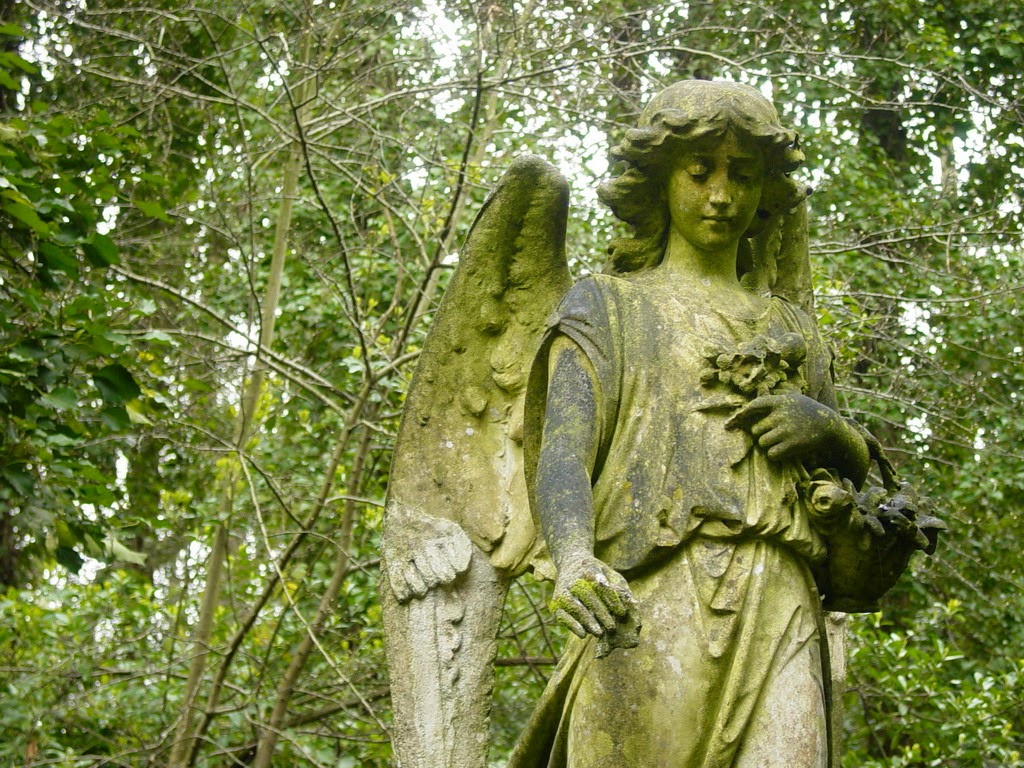
Beautiful and solemn: Highgate Cemetery

We've bashed through a fair few poems recently. Make sure you've got your head around them by reading through the Bitesize notes on Casehistory: Alison, The Horse Whisperer and On a Portrait of a Deaf Man.

It's the last poem I want to blog about because it's a belter. Why do I like this grim little poem about death? Perhaps it's because truly great literature deals with universal themes. The Romantic poet, John Keats said: 'Beauty is truth, truth beauty'. Cormac McCarthy, who wrote a novel about the end of the world ('The Road'), says that writing that is not about 'issues of life and death' is 'not literature'. What I love about this poem is that it presents the harsh truth of the reality of death without a sugary coating. We tend to live in denial about such things; great literature makes us confront these thoughts and deal with them. John Betjeman doesn't shy away from the darkest of thoughts in his grief. And he doesn't water his feelings down with euphemisms. But just like the dead wife in 'My Last Duchess', we are given a picture of the simple pleasures of life too: the food, the walks, the air. Perhaps part of the truth of this poem is that we cannot celebrate the beauty and joy of life without acknowledging the darkness of death. It's a poem of opposites.
http://en.wikipedia.org/wiki/Yin_and_yang


There's so much more to this poem than initially meets the eye. It's very carefully constructed, and there's loads to say about structure. Here's a recap of key points about this poem, and perhaps a few things we didn't notice first time around:


  • The poem is an elegy - a lament for the dead.
  • It's written in ballad metre. That means that lines 1 and 3 of each stanza are tetrameters (four stressed syllables); lines 2 and 4 are trimeters (three). This creates the same rhythm that you'll know from all those carol concerts in O Little Town of Bethlehem
  • The regular rhythm and rhyme creates various effects. It creates a sense of order and certainty - like the inevitability of death. It also makes the poem all the more blunt - even darkly comic.
  • A key idea in the poem is that the speaker cannot think of the positive memories of his father without being reminded of death. Even the images of food remind us of this: think of the fragile 'egg-shaped head' and the wrinkly 'potatoes in their skin' which reminds us that the father has swapped places with the potato. Later, the 'soil' he loved the smell of is also a reminder of his burial.
  • The poem is as much about the speaker's fear of death as it is about the father. Consider the 'loosely fitting shooting clothes' which become a 'closely fitting shroud'. A shroud is a burial cloth. The fact that they are now closely fitting is more a sign of the speaker's claustrophobia at the thought of burial than it is a description of the father's change in size.
  • It's a sensual poem - only the sense of sound is missing as the father is deaf (long silent walks/not the song it sung)
  • The oxymoronic description of a the tie, 'discreetly loud', reminds us that this poem is one of opposites: life and death, celebration and sorrow, faith and despair, freshness and decay. See the yin-yang symbol above. Perhaps it also tells us about the father's personality - confident, strong but understated.
  • Part of the Chinese concept of yin-yang is that opposites are interconnected. This is true of this poem. Within each stanza, the positive memories tie up with sadness and even horror. Eg. 'shake hands' links to 'finger-bones'; eating a potato, eating clay; the rain-washed air he loved and the soaked earth of Highgate Cemetery.
  • Remember, Carrara is an Italian town famous for its marble - often used for gravestones.
  • The final stanza is full of bitterness, anger and confusion. We don't know how long ago the father died, but the emotions are still raw. The fact that the poem is inspired by a portrait suggests that time has passed but has not healed. 'Thus' and 'thus' may well refer to the father's deafness and his death. There is a sarcastic tone to 'save his soul and pray.' Despite the direct address to God and the respectful capitalisation of 'You', there is no mention of an afterlife: 'I only see decay.' The ending of the poem therefore presents us with ambivalent feelings about God (ambivalent means mixed, conflicting feelings about something). He's questioning his faith - but doing it directly at God. The poem, as we have seen, is full of ambivalence.

I hope this helps. Think about how it connects to:

  • Casehistory: Alison (before/after; loss; faith)
  • Medusa (bitterness, anger and ambivalence) 
  • Brendon Gallacher (death, memory, loss)
  • Les Grands Seigneurs (sudden, harsh transformations)
  • Ozymandias (decay)
  • My Last Duchess (life and death)
  • The River God (nature, life and death)


Mr M


PS. Just had these two new thoughts about The Horse Whisperer:

1) Just like in Les Grands Seigneurs, the poems sudden transformation is shown in the verse form through sudden endings. In Horse, it is provided through a short final stanza; in Seigneurs, through short, skewed rhyming lines.

2) I mentioned how the images we get of horses are like close ups of small details ('shimmering muscles', 'eyes revolved') - I compared this to the early pages of the Gruffalo - before we meet him. This technique has a name: synecdoche (where a part of something is used to represent the whole: here specific parts of the horse are used to stand for the whole horse, effectively focusing the reader's attention.) Good, eh? If the Gruffalo passed you by, here's what I mean:


Now that's a cross-reference!

Mr M

Unseen Poetry: The Three Tick Method

Hello all,


On Tuesday, we discussed the best way of approaching the unseen poetry question.

To sum up this question (section B of the Lit Unit 2 - Poetry), you can expect:


  • A fairly straight forward poem
  • An extended metaphor or pattern of imagery to interpret
  • A question which requires you to discuss a) ideas, attitudes, feelings; and b) the writer's methods (language and structure)


So, how should you approach a new poem in exam conditions?

By using the Three Tick Method! I nicked this idea from a well known American edublogger and writer. Here's how it works:

1) Create three tick boxes in the top corner of the paper like this: 

2) Read the poem. Make a few notes about the mood/tone. (Perhaps at the beginning and end?) Tick the first box.

3) Re-read the poem. Make a few notes about techniques (Go for the most obvious ones - eg. metaphor, rhyme, structure). Tick the second box.

4) Re-read the poem. Make a note about the 'main idea' (perhaps the theme or meaning of the poem). Tick the final box.


Now you are ready to write. This process takes 4-5 minutes and gives you a way into the poem. You'll find more to say as you go. Feel free to add further notes as you go.


I was really pleased with how this seemed to work on Monday. A single reading is not always enough to 'get' a poem. This way, you'll hit the ground running when you do start to write. Don't be afraid to spend this time thinking and annotating first. 25 minutes is plenty of time for this answer.

Why not give it a go? You have some past questions and a model answer. Or you can look at this. Alternatively, have another look at these belters:

Love After Love

The time will come
when, with elation,
you will greet yourself arriving
at your own door, in your own mirror,
and each will smile at the other's welcome,

And say, sit here. Eat.
You will love again the stranger who was yourself.
Give wine. Give bread. Give back your heart
to itself, to the stranger who has loved you

all your life, whom you ignored
for another, who knows you by heart.
Take down the love letters from the bookshelf,

the photographs, the desperate notes,
peel your own image from the mirror.
Sit. Feast on your life.


Derek Walcott


Mr M

My Last Duchess: Context and final thoughts

Hi,


Lucrezia de' Medici, generally believed to be My Last Duchess
In this post, I'm going to go over a bit of historical context, recap the story of the poem, and discuss the ending, which was rushed at the end of last lesson.

Context:

The speaker is most likely Alfonso II d'Este, the fifth Duke of Ferrara (1533–1598), who, at the age of 25, married Lucrezia di Cosimo de' Medici, the 14-year-old daughter of Cosimo I de' Medici, Grand Duke of Tuscany, and Eleonora di Toledo.
 
Lucrezia was not well educated, and the Medicis could be considered "nouveau riche" in comparison to the venerable and distinguished Este family (the Duke's remark regarding his gift of a "nine-hundred-years-old name" clearly indicates that he considered his bride beneath him socially). 

She came with a sizeable dowry, and the couple married in 1558. He then abandoned her for two years before she died on 21 April 1561, at age 17. There was a strong suspicion of poisoning.The Duke then sought the hand of Barbara, eighth daughter of the Holy Roman Emperor Ferdinand I and Anna of Bohemia and Hungary and the sister of the Count of Tyrol, Ferdinand II. The count was in charge of arranging the marriage; the chief of his entourage, Nikolaus Madruz, a native of Innsbruck, was his courier. Madruz is presumably the silent listener in the poem. The other characters named in the poem, painter Frà Pandolf and sculptor Claus of Innsbruck, are fictional.

The poem

The poem is set during the late Italian Renaissance. The speaker (presumably the Duke of Ferrara) is giving the emissary of the family of his prospective new wife (presumably a third or fourth since Browning could have easily written 'second' but did not do so) a tour of the artworks in his home. He draws a curtain to reveal a painting of a woman, explaining that it is a portrait of his late wife; he invites his guest to sit and look at the painting. As they look at the portrait of the late Duchess, the Duke describes her happy, cheerful and flirtatious nature, which had displeased him. He says, "She had a heart – how shall I say? – too soon made glad..." He goes on to say that his complaint of her was that "'twas not her husband's presence only" that made her happy. 

Eventually, "I gave commands; then all smiles stopped together." He now keeps her painting hidden behind a curtain that only he is allowed to draw back, meaning that now she only smiles for him - just as we wanted it. The Duke then resumes an earlier conversation regarding wedding arrangements, and in passing points out another work of art, a bronze statue of Neptune taming a sea-horse. Throughout the whole poem you get the sense that the Duke owns his wife.

In an interview, Browning said, "I meant that the commands were that she should be put to death . . . Or he might have had her shut up in a convent."

Structure - the importance of the ending


In terms of structure, the ending of the poem is vital because we don't realise the true purpose of this meeting until the end. It completely changes the tone and meaning of the entire poem from casual conversation into pointed warning. The words 'looking as if she were alive' at the start now seem like cruel mockery. Here are my notes on the ending:

We learn that the whole conversation about the painting is planned. The Duke is sending a message to the Count's daughter to not make the same mistakes as the last duchess.

It is obvious from this ending that they had previously been discussing the 'object' of this meeting (the daughter) and, perhaps more importantly, the dowry. His point about the dowry here is basically this: Everyone knows the count is rich and generous, so I know you won't mess me about over the large dowry I'll be demanding.

Is the dowry the real 'object' of his desires?

The final image is hugely significant. He killed his wife because he couldn't tame her. He likes to think of himself as having the power of Neptune in the statue.
    
This is a very famous poem which has a long critical history. There's plenty of information about this poem online. Here's GCSE Revision's YouTube translation and analysis of the poem:


This is a great poem to write about in the exam; it compares well to poems such as Ozymandias, The River God, Les Grands Seigneurs etc. However, it is tricky to get your head round at first. Get to know it inside out, and there's a good chance you'll get to use that expertise in the exam.

If you feel like you need more help with this or any other poem, please comment, email or catch me in school.


Mr M

Friday, 3 April 2015

Post-lesson poetry write ups

Hi Y11,

See! Your very own revision egg!


Last year, the run-up to the exam was a particularly tight thing. It was speed poetry at its speediest. Because of this, I decided to write a series of post-lesson write ups to ensure that key ideas about each poem didn't get lost in the rush.

This year, we've got more time to prepare properly and to make sure that you've thought about the links between the poems.

But I thought it would be useful to put all of those posts together in one place so that you can look at them when you need to. So here they are:


My most popular post is still this model answer to a question comparing 'Ozymandias' to 'The River God'.

You can find lots of other poetry resources by clicking on 'Character and Voice' in the browse by topic menu, here --------------------------------->

Finally, some links for poems which are not mentioned above. Here are two essential articles on 'Medusa' and 'Singh Song' by the authors themselves.

Happy revision. As always, feel free to get in touch with any questions about the poetry - or the exams in general.


Mr M


Wednesday, 1 April 2015

What do the Lit papers look like?

Hello.


Here are some past papers for your viewing pleasure. Remember, your Literature exams are:

English Literature Unit 1: Exploring Modern Texts (Of Mice and Men and An Inspector Calls)
English Literature Unit 2: Poetry Across Time (Poetry Clusters and Unseen Poetry)...

There is a higher and foundation paper for each exam below. Make sure you pick the right one.

Please follow us on Twitter. Last year I tweeted out links to past papers - it's quicker and easier than uploading them here - and I'll be doing the same again shortly.

Anyway, here are some papers. Don't say I never give you anything!


Mr M

Exam Guides

Hello again,


Here are my guides to your three exams. 

In the coming days, I'll post some past papers so that you can get a feel for each paper.

Please check the exam dates against your exam timetables and let me know if I've got anything wrong....

I've put these guides in the order that you'll sit the papers:


I hope these help. 

If you have any questions about your English exams, please feel free to comment here or ask me via Twitter.


Mr M

Easter Revision

Hello Year 11,


Things have been a bit hectic recently, and with the rush to finish the Of Mice and Men assessment (damn that fire drill!) I didn't really get much time to talk to you all about Easter revision.

Now that I've caught up with a bit of sleep and feel half human again, my intention is to do a daily revision blog over the rest of the Easter holidays. Sad, I know.

Some of the posts will be brand new; others will be salvaged from last year. Make sure you don't miss anything by:

a) Putting your email address into the little 'follow by email' box over here ------>
b) Following us on Twitter: https://twitter.com/beverleyhigheng

To kick off, here is my advice about your priorities for revision:


A major focus for Easter should be poetry. It's been a while since you studied the poems, and when you get back we'll be looking at how to compare them. I've been asked how to approach poetry revision. Here are my suggestions (from easiest to most demanding):

1) Read the poems (ignore the notes) over and over. This is the MOST IMPORTANT thing you can do.
2) Go over your notes and work in ex. books.

3) Use BBC Bitesize and this blog. 
4) Use the study guide I emailed out.
5) Write up revision notes / cue cards etc. Research suggests that writing by hand has a greater impact on memory than reading or typing notes. I've seen some amazing revision notes in form time recently!
6) Fill out comparison grids on pairs of poems (see below).
7) Try a past paper!


Here's the poetry comparison grid. If you can fill one of these out about a pair of poems, then you will be able to write about them in the exam:


Advice about how to compare poems in the exam:


Coming soon: EXAM GUIDES


Happy revision (and Easter),


Mr M 

Wednesday, 21 May 2014

Thursday's exam: Poetry

Hi Y11,


Just a quick post to remind you about what you have to do on Thursday, and how best to revise. 

First of all, here's the exam guide for this paper:


Past papers are available on the AQA website. I tweeted links to every past paper yesterday. Search our timeline: @BeverleyHighEng

Apart from your annotated anthology and other notes from class, the best place to go to make sure you know the poems is BBC GCSE Bitesize.

The good news is that Section A usually allows you to write about one of your favourite poems. There's usually one question which is quite open (eg. how is a character presented through language?) which will give you options. 

Check out each of the past papers and decide what you would have done for each one. This will tell you exactly how ready you are for the exam. 

My advice is to revise the poems in thematic clusters and to think about how they compare. The docs below give you some ideas about how to compare and contrast two poems:


You can also find more blog posts about the poems by browsing by topic on the right hand side of this blog's homepage. My most popular blog post is this model answer to a question on Ozymandias and The River God.

As for Section B (Unseen Poetry), please look here for my thoughts about how to approach an unseen poem. Don't fear it. They don't pick anything too difficult - but do expect a simple poem with a central metaphor. Ask yourself: what is this poem really about? Again, check out the past papers and see how you react when faced with an unseen poem.

Finally, make sure you know all your poetic terms by taking a look here.


Good luck everyone!

Please feel free to comment or tweet your last minute, panicky questions!


Mr M


Friday, 2 May 2014

Updated: GCSE English Language and English Literature Exam Guides

Hi,

Here are my updated guides to your three exam papers in the order that you will sit them:


I hope these help. You can find past papers here (just click the qualification you want and then 'past papers and mark schemes' from the menu on the left of the screen) or elsewhere on this blog.


Mr M

Tuesday, 29 April 2014

Unseen Poetry - The Three Tick Method

Hello all,


On Monday, we discussed the best way of approaching the unseen poetry question.

To sum up this question (section B of the Lit Unit 2 - Poetry), you can expect:


  • A fairly straight forward poem
  • An extended metaphor or pattern of imagery to interpret
  • A question which requires you to discuss a) ideas, attitudes, feelings; and b) the writer's methods (language and structure)

So, how should you approach a new poem in exam conditions?

By using the Three Tick Method! I nicked this idea from a well known American edublogger and writer. Here's how it works:

1) Create three tick boxes in the top corner of the paper like this: 

2) Read the poem. Make a few notes about the mood/tone. (Perhaps at the beginning and end?) Tick the first box.

3) Re-read the poem. Make a few notes about techniques (Go for the most obvious ones - eg. metaphor, rhyme, structure). Tick the second box.

4) Re-read the poem. Make a note about the 'main idea' (perhaps the theme or meaning of the poem). Tick the final box.


Now you are ready to write. This process takes 4-5 minutes and gives you a way into the poem. You'll find more to say as you go. Feel free to add further notes as you go.


I was really pleased with how this seemed to work on Monday. A single reading is not always enough to 'get' a poem. This way, you'll hit the ground running when you do start to write. Don't be afraid to spend this time thinking and annotating first. 25 minutes is plenty of time for this answer.

Why not give it a go? You have some past questions and a model answer. Or you can look at this. Alternatively, have another look at these belters:

Love After Love

The time will come
when, with elation,
you will greet yourself arriving
at your own door, in your own mirror,
and each will smile at the other's welcome,

And say, sit here. Eat.
You will love again the stranger who was yourself.
Give wine. Give bread. Give back your heart
to itself, to the stranger who has loved you

all your life, whom you ignored
for another, who knows you by heart.
Take down the love letters from the bookshelf,

the photographs, the desperate notes,
peel your own image from the mirror.
Sit. Feast on your life.


Derek Walcott


Remember, after school on Thursday we'll be looking at the OMAM part b question - and in Friday's lesson we'll move on to An Inspector Calls.


Mr M

PS. The English Department now has a Twitter account. Just search for BeverleyHighEng and get following. I'll tweet links to all future blog posts.

PPS. Several of you still owe me Easter homework. Friday please, or I'll be on your case.